Free AI Receptionist for Small Business: What Free Covers
One free tier is real: 25 live calls at $0, then $3.00 a call. What free AI receptionists include, what they leave out, and what month two costs.
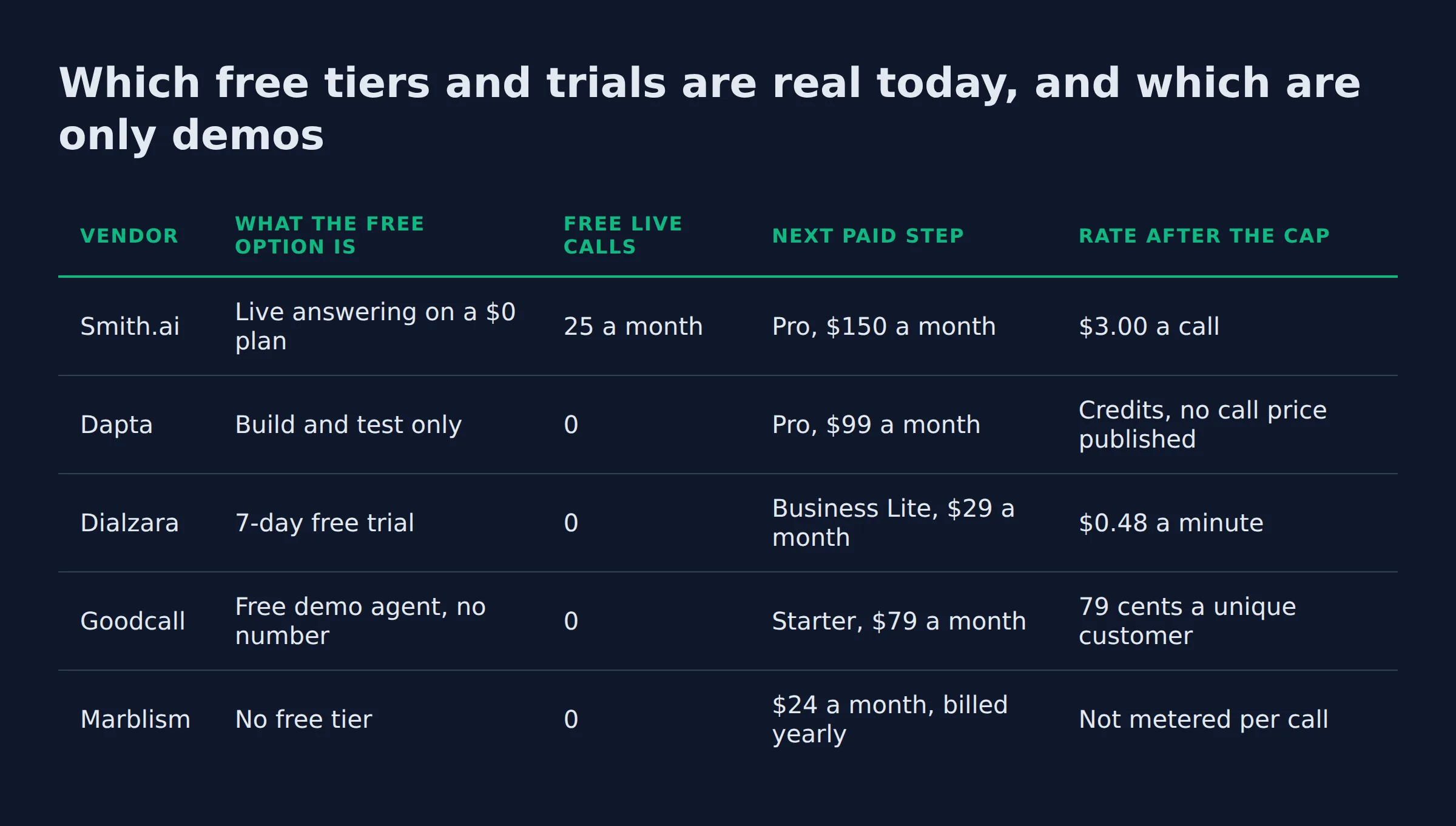
A free receptionist answers the first 25 calls. The 26th one tells you what the plan actually costs.
The catch sits in the unit. Every vendor counts a call differently, and free is the plan where the counting matters most.
Yes, one tier is real. Smith.ai’s AI receptionist answers 25 live calls a month for $0, then bills $3.00 a call. The other vendors we read give a 7-day trial or free build-and-test time instead of free live answering. Real free answering stops at 25 calls, and paid plans start at $29 a month.
TL;DR
- One free tier answers real callers today: Smith.ai, 25 live calls at $0, then $3.00 a call.
- Dialzara is a 7-day trial of a $29 plan. Goodcall and Dapta are free build-and-test. Marblism lists no free tier.
- 25 calls is about 0.8 a day. The $0 plan stops being the cheapest option at 75 calls a month.
- At 100 calls the month runs $212.50 on the paid plan and $225 on free. At 300 calls, staying on free costs $825.
Most pages on this keyword are a walkthrough of one vendor’s signup form. This is the plain version: every free tier we could read on 31 October 2026, side by side, plus the arithmetic for month two.
What does a free AI receptionist actually include, and what does it leave out?
A free tier usually includes the whole build: answering calls, a greeting you write, and answers to your common questions. It leaves out volume, custom prompting, custom integrations, and often warm transfer. Free is the product with the expensive parts switched off.
That list looks the same across vendors. The billing unit does not.
- A live call, counted one by one, with an overage rate per call.
- A talk minute, counted by time on the line.
- A unique caller, counted once however often they ring.
- A credit or a work hour, counted against a general allowance.
Smith.ai counts real calls. Its page marks custom AI prompting and custom integrations as Not included on Free. The Free column of that table shows Enterprise as the first plan where both appear. Lead qualification, call routing and call summaries do sit inside Free, so the base product is real work.
Dialzara sells 60 talk minutes. Goodcall counts unique customers, so 3 short calls from one person cost the same as one.
Dapta sells credits and never converts them to calls. That is the gap that makes its free account hard to budget.
The billing unit decides which plan is cheap for you, and no two vendors on this list use the same one.
Which free tiers and trials are real today, and which are only demos?
Only Smith.ai gives free live answering today. Dialzara runs a 7-day free trial on a $29 plan. Goodcall and Dapta let you build and test for free without a live number. Marblism lists no free tier at all.
A demo agent and a free live tier are different products, and only one of them answers a customer.
| Vendor | What the free option is | Free live calls | Next paid step | Rate after the cap |
|---|---|---|---|---|
| Smith.ai | Live answering on a $0 plan | 25 a month | Pro, $150 a month | $3.00 a call |
| Dapta | Build and test only | 0 | Pro, $99 a month | Credits, no call price published |
| Dialzara | 7-day free trial | 0 | Business Lite, $29 a month | $0.48 a minute |
| Goodcall | Free demo agent, no number | 0 | Starter, $79 a month | 79 cents a unique customer |
| Marblism | No free tier | 0 | $24 a month, billed yearly | Not metered per call |
Our own sweep of the same pricing pages found 5 of 6 vendors with no free tier at all. For the wider view, read the full AI receptionist price comparison.
Smith.ai puts its Free plan first on the page. The plan includes 25 real calls, 25 test calls and 50 simulated calls a month before the per-call rate starts.
Dapta’s free AI receptionist walkthrough is clear that the free account covers the build and the test calls. Live customer calls use credits, so the free plan ends when the phone starts ringing.
Goodcall call pricing sells a free demo agent instead of a free line. You build it, hear it answer, and pay when you connect a number. Marblism pricing starts at $24 a month on yearly billing and bundles an answering agent with 6 others, with no free tier listed.
How far do 25 free calls a month go for a one-van business?
25 calls is about 0.8 calls a day, or one call every 29 hours. That covers after hours and lunch for a one-van crew. It does not cover a busy Monday. Calls past 25 bill at $3.00 each, so nothing gets blocked.
The calls that matter here are the ones you already miss. After hours, mid-job, and the Saturday morning rush. Those are the 3 buckets a free tier fills first. A one-van crew cannot answer any of them with a phone in a cupholder.
I see the same thing in my own work. When I hand a finished site to a home-service prospect, the phone starts ringing that same week. Nobody has been hired to answer it yet.
Put a wage number against that. The O*NET receptionist wage data puts the median receptionist wage at $18.27 an hour for 2025. That is $38,010 a year for occupation 43-4171.00, or about 30 cents a minute.
A 3-minute call costs about 91 cents of staff time. At $3.00 a call, the AI costs roughly 3 times the human minute. The purchase is coverage of hours nobody works, and that is the number to judge it on.
The 75-call break-even that no vendor page prints
The $0 plan and the $150 plan cost the same at exactly 75 calls a month. Past that point, free gets more expensive than paying.
| Calls a month | $0 plan, billed per call | Cheapest paid path | Difference |
|---|---|---|---|
| 50 | $75 | $150 | Free is $75 cheaper |
| 75 | $150 | $150 | Dead even |
| 100 | $225 | $212.50 | Paid is $12.50 cheaper |
| 300 | $825 | $500 | Paid is $325 cheaper |
That table is my arithmetic on the published rates. The $0 plan bills extra calls at $3.00, the $150 plan at $2.50, and the top tier at $2.10. Two things follow. A spike month costs more on free than on a paid plan. A steady month at 60 calls still lands under $150.
I run about 200 form submissions a day through my own outreach system, and each one gets an automatic first reply. The cost sits in covering the hours, not in the message. A phone line behaves the same way.
The free plan carries the highest per-call rate Smith.ai publishes, so the $0 label does a lot of work past 75 calls.
What does the month cost after the free tier ends?
Month two runs $29 to $150 for most small shops. Dialzara Lite is $29 for 60 talk minutes, Goodcall Starter is $79 for about 150 calls. Smith.ai Pro is $150 for 75 calls. At 300 calls, Smith.ai’s $500 plan wins.
| Plan | Published price | What it includes | Cost per call |
|---|---|---|---|
| Dialzara Business Lite | $29 a month | 60 talk minutes | About $1.93 at 4-minute calls |
| Goodcall Starter | $79 a month | 100 unique customers, about 150 calls | About 53 cents |
| Smith.ai Pro | $150 a month | 75 real calls | $2.00 |
| Marblism | $24 a month, yearly billing | 50 hours of work across 7 agents | No per-call price |
Cost per call is my arithmetic again: plan price divided by the calls or minutes inside it. Dialzara’s 4-minute figure assumes an average call length, which the page does not publish. Dialzara pricing lists $0.48 a minute after the 60 included minutes, so the number moves with how long people talk.
The minute plan is the one that surprises owners. $29 reads cheap until the division is done, and 60 minutes is 15 calls at 4 minutes each. A home-service call often runs longer than that, because the caller is describing a job.
Goodcall prices the other way, by unique customer. Its page compares a live answering service at $1.50 to $1.90 a minute against roughly 13 cents a minute on Starter at 4-minute calls. That comparison is the vendor’s own, and the arithmetic checks out on the published numbers.
Price per call is the only line that lets you compare a minute plan, a caller plan and a call plan.
I check the per-unit number before anything else on a new tool, because the headline price hides the division.
What can a free AI receptionist not do for a clinic, a restaurant or a home service crew?
It cannot take a payment, judge an emergency, or quote custom work. On a free plan it also comes without custom prompting and without a signed business associate agreement. Vertical rules matter more than the feature list.
- Clinic or dental office: patient calls carry health details. Ask for a signed HIPAA business associate agreement and a SOC 2 Type II report before any patient call reaches the agent. Keep clinical advice out of the script. Free plans rarely let you rewrite the prompt to enforce that.
- Restaurant: volume is the blocker. 25 calls does not last a Friday. Walk-in questions need same-day answers, and those answers need a booking tool. Appointy, Acuity and Calendly all do that job.
- Home service and HVAC: emergency triage, quote ranges and dispatch need a warm transfer to a person. Dialzara pricing moves warm transfer and after-hours escalation to the $99 plan. Calendar sync and bilingual answering move there too. None of the 4 sit on the $29 plan.
- Insurance and property management: the agent has to look up an existing record in a CRM. Most free tiers list that lookup as a custom integration. The common CRMs here are HubSpot, Salesforce and Clio.
Getting those rules right matters more than any feature row. The plans that skip warm transfer are the ones to avoid for emergency trades.
How do you run a free tier on your own line without losing a caller?
Forward only the calls you already miss. Keep your main number. Write a greeting that names the AI and test the handoff to a person. Confirm the booking lands in your calendar before forwarding goes live.
Three test calls teach you more than the feature table: one booking, one angry caller, one hang-up.
- Number: keep your business number and forward to the agent’s number. Goodcall call pricing states that forwarding keeps your existing number. Dialzara pricing goes further, since it forwards or ports the number. Confirm which one your vendor does before you build.
- Test calls: Smith.ai’s Free plan includes 25 test calls and 50 simulated calls a month. That is enough to rehearse the awkward ones before a real caller hears the agent.
- Booking: Smith.ai Free lists AI scheduling with Calendly, and the native integrations row includes Clio and Zapier. Dialzara’s calendar sync starts on the $99 plan, though its $29 plan does list Zapier and Make integrations. For the sequence from ring to booking, see how a voice agent handles a call from ring to booked job.
- Disclosure: say in the greeting that the caller is talking to an AI. Callers handle it better than owners expect, and it protects you on the recording.
- Outbound: the FCC ruling on AI voice calls confirms that AI-generated voices fall under the TCPA’s “artificial or prerecorded voice” rules. That means prior express consent for outbound calls. Inbound greetings you write are a separate matter.
- Junk calls: ask whether robocalls and wrong numbers burn the allowance. On a 25-call cap, one week of spam can eat the month.
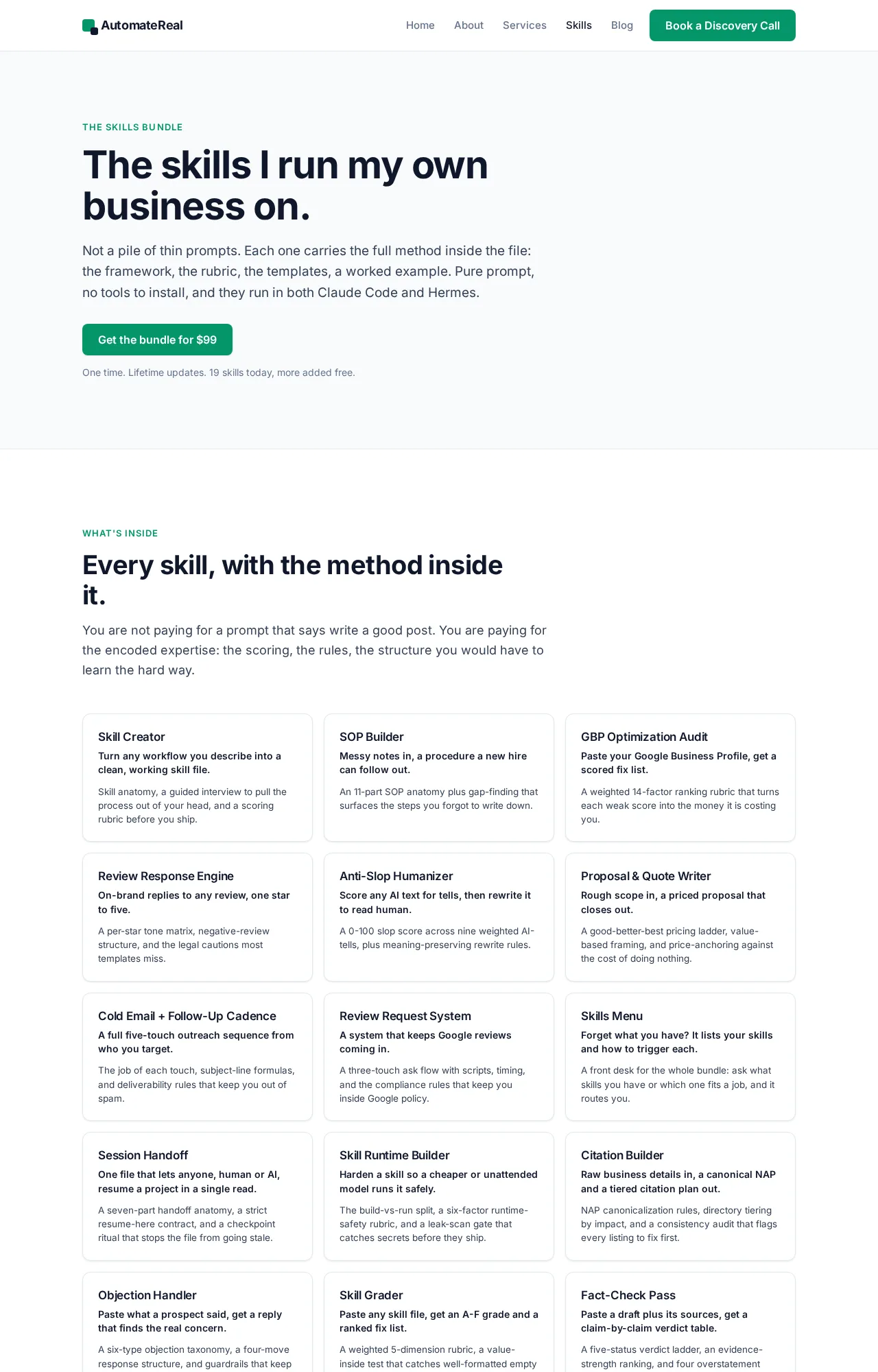
I write the greeting and the handoff rules before I open a vendor page. Those are prompts, and they cost nothing to get right. The ones I use most are in the skills bundle at automatereal.com/skills, all skills for $99.
AutomateReal skills
What we could not verify today
- Rosie and Lucy (Curious Thing) both returned bot walls, so this page prints no free-call count for either.
- Ruby and Slang.ai pricing was not read for this page, so neither appears in the table.
- Retell AI, Vapi, Bland AI and Twilio are build-it-yourself platforms, and their per-minute rates were not read.
- Smith.ai did not state number porting terms in the sections we read. Dialzara states it plainly: forward or port your number, or a new local or toll-free number.
- Google positions for this keyword were not checked, so no ranking claim is made here.
Every number on this page came from a page we read. Where we could not read one, we printed nothing.
Should you stay on free, or pay $29 to $150 a month?
Stay on free below 75 calls a month. Move to a paid plan when you pass 75 calls. The same applies once you need custom prompting, calendar sync or warm transfer. For most one-van shops, free covers after hours first.
- Under 25 calls: free is the honest answer, and the overage never starts.
- 25 to 75 calls: free is still cheaper than $150, so watch the invoice rather than the plan page.
- Past 75 calls: the paid plan wins on its own arithmetic, before you count the features.
- Clinic, restaurant or emergency trade: skip free, because the compliance and transfer features sit on the paid tiers.
The first month is the test. Keep a note of every call the agent handled and every one it fumbled, then compare that list to the invoice. That comparison is the only reason to upgrade.
I would start on free and let the first invoice make the call.
The plan page cannot answer this. Your own call log for the first month can.
AutomateReal services
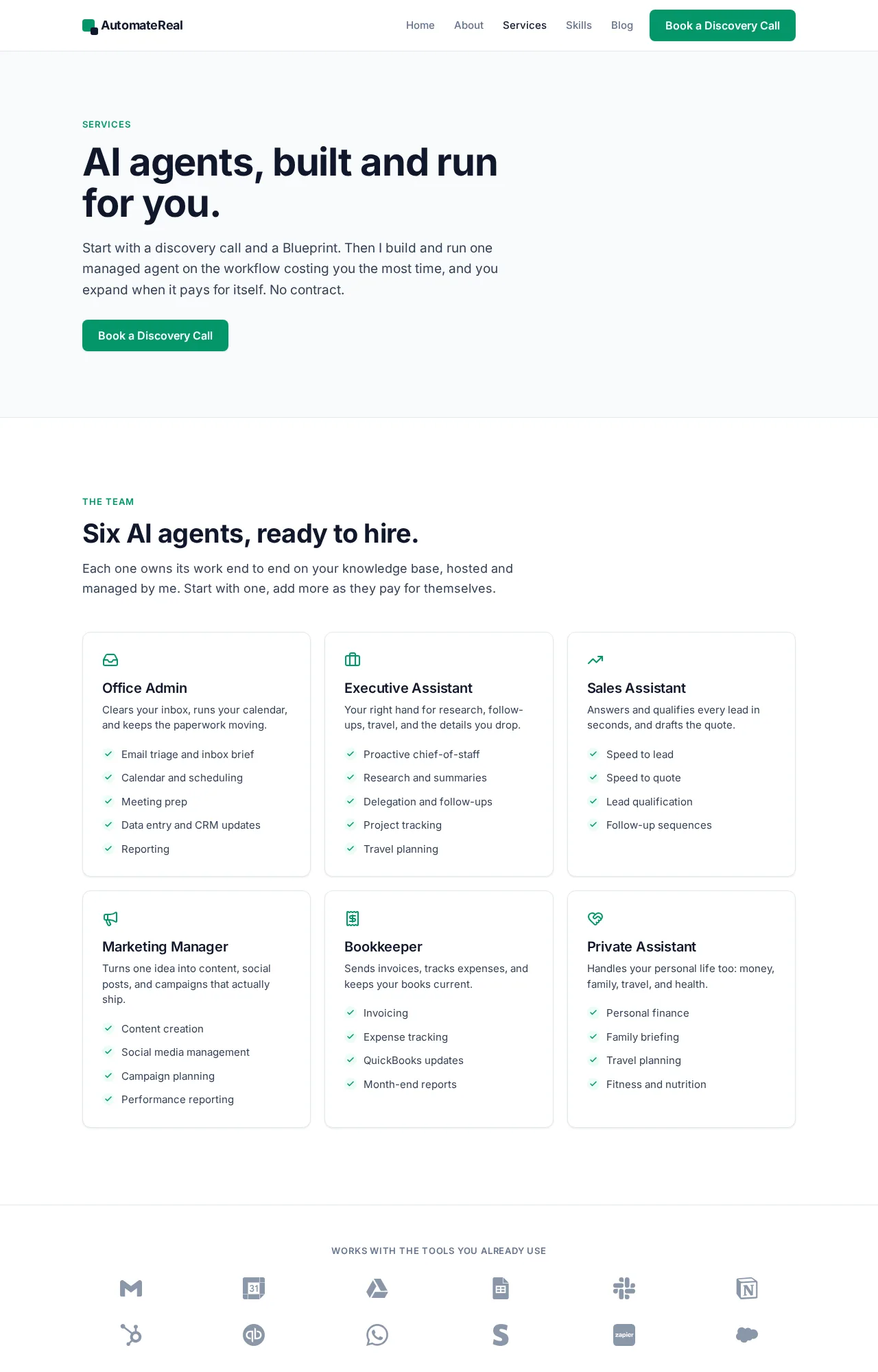
If you want the line and the greeting built before you commit to a plan, the AI services page covers how a setup runs. A discovery call maps that first workflow in about thirty minutes.
Related: AI voice agents for small business
FAQ
What happens if a busy month pushes 60 calls through a 25-call free tier?
It bills the extra 35 calls at $3.00 each, so that month costs $105. That is still $45 less than the $150 plan, and one busy month does not justify upgrading.
Do the free plans include call recordings, transcripts and summaries?
Smith.ai lists recording, transcription and summaries as core features on its Free plan. Dialzara ticks recordings and summaries on the $29 plan. Goodcall’s Starter plan lists 30-day call history instead.
Can a free plan book straight into Google Calendar, or is booking a paid add-on?
On Smith.ai, scheduling sits inside the Free plan, listed with Calendly. On Dialzara it is a paid row, with calendar sync switched off on the $29 plan and on from $99. Check the booking row before you assume.
Is one free line enough for after-hours calls only?
Usually it is. After-hours volume on a one-van crew rarely passes 25 calls a month, and 25 calls works out to about 0.8 a day. Track it for 30 days before you buy anything.
Can I move from free to paid without changing my business number?
Goodcall states that call forwarding keeps your existing business number. Dialzara answers the same question on its pricing page: forward or port your number, or take a new local or toll-free number it issues. Smith.ai did not state porting terms in the sections we read, so ask support before you build on a number you plan to keep.