Custom AI Agent Development Company: How to Vet One
What a custom AI agent development company builds, what it costs, and the contract terms to check before you sign.
The quote arrives as one number and one word. Agent. The scope is 3 lines, the demo works, and the deposit is due on signature. Then you ask how it handles an email that was not in the demo, and the call goes quiet.
A custom AI agent development company builds an agent around your process instead of selling you a tool to configure. It scopes the workflow, then connects the agent to the systems you already use. It tests the result on real cases and hands over something you own and can run.
The pages ranking for this phrase come from companies selling the build. This one covers the buyer’s side. The demo test, the 30 cases, and the 6 contract lines are below.
So is the plan for the day the vendor stops answering.
TL;DR
- 78% of organizations reported using AI in 2024, up from 55% the year before (AI Index Report).
- Vendor estimates put a basic custom agent at $25,000 to $50,000, with a narrow first build at 6 to 10 weeks (published cost ranges).
- Prompt injection is the number 1 risk on the OWASP Top 10 for LLM applications.
- My own lead intake takes about 200 form submissions a day. The failed queue is what catches a real break each week.
What does a custom AI agent development company build that a tool cannot?
It builds the decision layer. The build decides which step runs next and what counts as done. It also names who gets called when the answer is unclear. A tool gives you fixed steps to configure.
Every custom AI agent development services quote rests on that split, and Anthropic draws the same line in its own engineering writeup. Workflows run through predefined code paths that someone wrote in advance. Agents direct their own steps and tool use, so the model holds the control.
The plumbing half has a standard now. MCP is an open-source standard for connecting AI applications to external systems. A good build wires your CRM and inbox through it instead of writing one-off glue per integration.
You will hear framework names on the call. Ask what each one buys you.
I run agents for my own marketing and lead intake, and the choice that mattered there was what each one is allowed to touch. That is a permission question, and it sits above the framework choice.
LangGraphandLangChainfor orchestration and state between stepsCrewAIwhen the work splits into roles, which is what people mean by a multi-agent systemMicrosoft Copilot Studioif your stack is already Microsoft- retrieval-augmented generation over a vector database when answers must come from your own documents
GPTandAnthropic Claudebehind the model call, with OpenAI or Anthropic as the provider
Agent types get named too, and those names are older than the tools above. The cost breakdown sorts them into 6 families:
- reactive, which returns a set response to a set input
- model-based, which keeps an internal picture of the state it acts on
- goal-based, which plans a path to a stated outcome
- utility-based, which picks the option that scores best on your measure
- learning, which adjusts from feedback over time
- collaborative, where the system works alongside other agents or alongside people
Agentic AI is the umbrella term for all of it. Your build is usually goal-based with a fixed tool list, and that shape is what makes a test set possible.
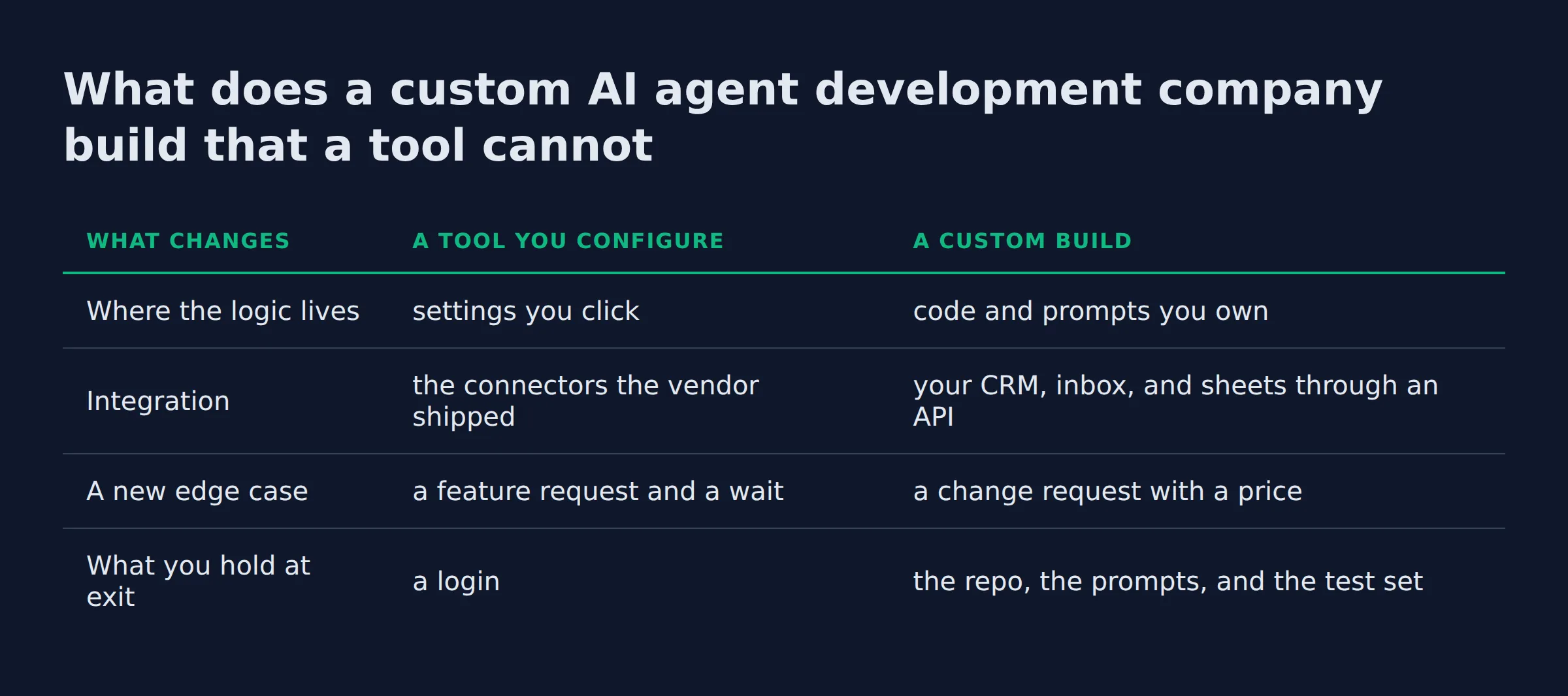
| What changes | A tool you configure | A custom build |
|---|---|---|
| Where the logic lives | settings you click | code and prompts you own |
| Integration | the connectors the vendor shipped | your CRM, inbox, and sheets through an API |
| A new edge case | a feature request and a wait | a change request with a price |
| What you hold at exit | a login | the repo, the prompts, and the test set |
Where an agent is the wrong purchase
An agent is the wrong buy when the job is one step. Skip it when the rules are stable or the answer must be identical every time. Code the checklist and keep the money.
One vendor page on this result says it out loud. Capital Compute lists a single-step task and a deterministic process as cases where a function or a plain workflow beats an agent. That admission costs a company that sells agents something. That is why you rarely read it.
The cheaper option has a name. Workflow automation runs fixed steps on a schedule, and it is the right buy for repeatable work with stable rules. For a team under 20 people, that is usually the right first buy.
The first sentence of the vendor’s answer tells you which one you are being sold. If the plan starts with a fixed sequence of steps, you are buying automation with an agent’s label on it.
The test I use fits on one line. If a new hire could be trained on the job with a one-page checklist and no judgment, the job belongs in code.
Run that test before any call. It saves you a quote.
How do you scope the first agent so it actually ships?
Choose one workflow that runs every week, has a countable output, and costs hours you can name. Write done as a condition a stranger can check. Cut scope until 4 weeks covers it.
The scoping line that decides the project is the definition of done, and most of them read like a promise. “Handle inbound leads” is a promise. “Route 95 of 100 sample leads to the right owner with no human edit” is a test.
I take about 200 form submissions a day into a system I built myself. When I rebuilt its routing, the line that mattered came before any model choice. What happens to a submission that matches no rule? Answer that early. It decides the queue your team works every morning.
Score candidate workflows on 3 numbers before you pick one:
- runs per week
- minutes each run costs today
- cost of one wrong output
High minutes and a cheap error make a good first build. Anything that touches money, safety, or a regulated record waits for level 2 or 3 of the ladder below.
AI agent development for small business usually means one workflow and one owner. Resist the second workflow until the first one has run for a full month.
Fine-tuning is the line item to question. It retrains a model on your data, and it brings a maintenance job that retrieval over your own documents does not.
Appinventiv’s cost writeup puts a basic agent at $25,000 to $50,000 (its price table). The same page gives 6 to 10 weeks for that band. Treat both as vendor numbers and hold phase one to 4 weeks.
If you have not picked who builds it yet, the agency, freelancer, or in-house hire decision changes the scope question.
The autonomy ladder: 3 levels, and the order to buy them
Phase the work in 3 levels: assistive, supervised, bounded autonomous. Each level changes what the agent may do alone, so each one is a place you can stop paying without losing what runs.
| Level | The agent may | You sign off on | A good first job |
|---|---|---|---|
| Assistive | draft a reply or a record, take no action | every output | pull fields from an inbound email into a sheet |
| Supervised | act, with a person approving first | the approval step | draft a quote from a call note |
| Bounded autonomous | act alone inside limits it cannot cross | the limits and the exception queue | send routine follow-ups under a value cap |
Each level ships as a working system. That is the point of the order. You get a usable result at level 1 in weeks, then decide whether level 2 earns its next payment.
Most “fully automated” claims you will read are level 2 with a fast approver. Ask which level you are buying, and get the answer in those words.
What should the working demo prove before you pay?
The demo should run your data, inside 2 of your tools, on 3 cases you pick live. Ask for the case it will fail. A build team shows you the failure and the log line that caught it.
Any AI agent development company should expect this question in the first call. The 3 words below get used for the same deliverable, and they are not the same purchase.
A proof of concept shows the workflow is possible. A prototype shows it works with your data and your systems. Production adds permissions, logging, and an owner for the exception queue.
Demos hide things in the same 4 ways:
- inputs chosen by the vendor
- one clean document instead of your messy folder
- a person typing in a back channel
- a model swapped in behind a scripted prompt
Two more terms to make the vendor define. Human in the loop is the approval step at level 2, and you want to see where it sits. Observability is the logging that shows what the agent did and why, and it should live in an account you can open.
I build free websites for prospects before they pay me anything, and that habit taught me how much a working artifact settles. A demo you can click beats a slide about the demo. It is also why I ask a vendor for the artifact every time.
I run the AI SEO pipeline that produced this article. It is a multi-agent system with a reviewer stage, and that stage rejects drafts. Each rejection arrives with a reason line, and the reason line is the useful part.
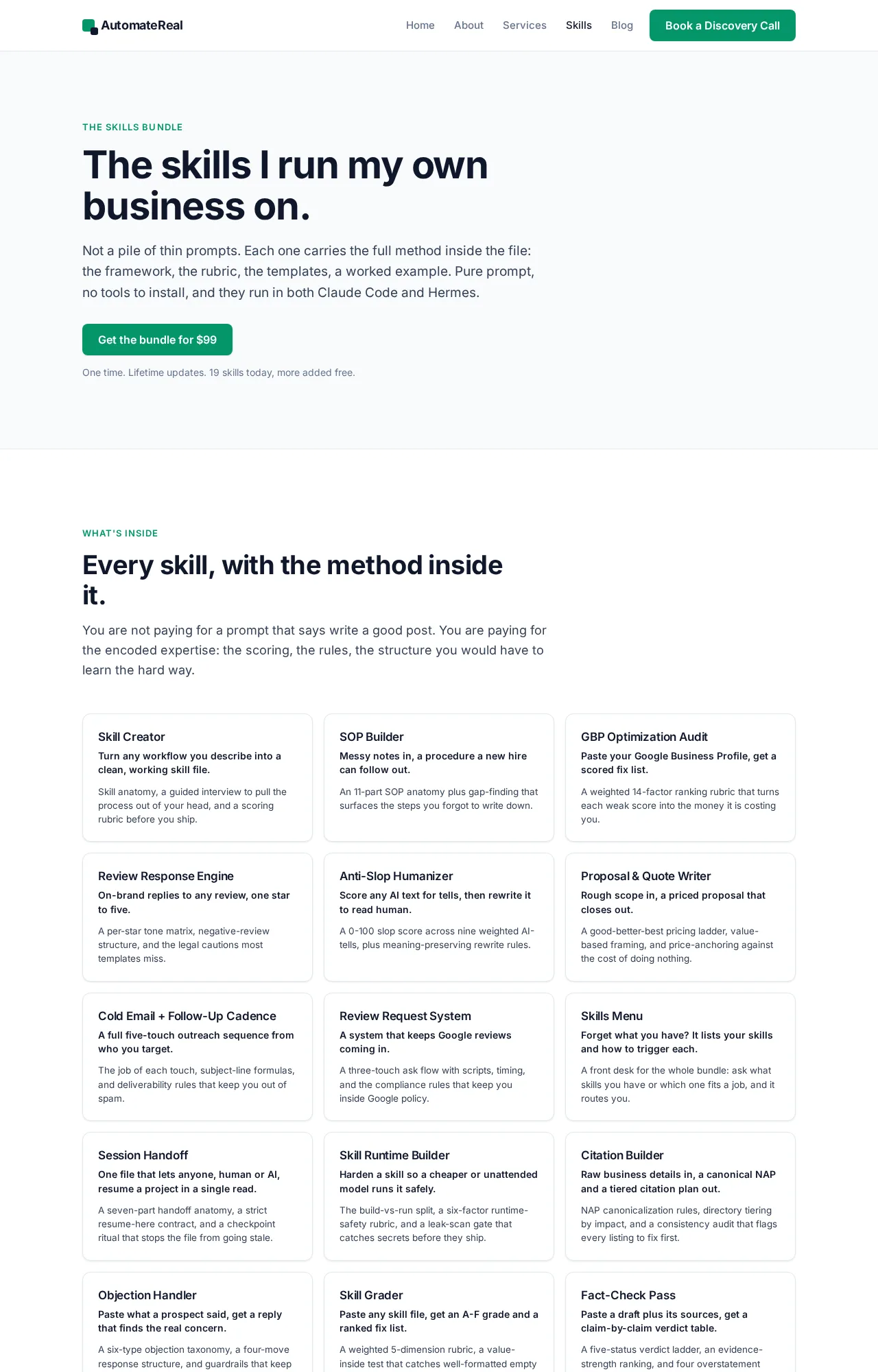 AutomateReal skills
Ask any vendor to show you a rejection and the reason that came with it. A team that has never rejected its own build has never tested it.
How do you test an agent before it touches a real customer?
Score the agent against 30 real cases with the right answer written down first. Hold 10 back. Add 3 hostile inputs: a prompt injection, a blank message, and a request outside its limits.
Prompt injection sits at LLM01 on the OWASP Top 10 for LLM applications. It works by putting instructions inside content the agent reads, so a lead form or an email body can try to rewrite its job. Your test set needs one attempt.
Guardrails are the rules that stop an action before it runs. Read them line by line, because a guardrail you cannot read is a promise.
The controls that stop the damage are boring and specific:
- least privilege, so the agent’s login reaches only the 3 records it needs
- role-based access control that separates who approves from who edits
- an audit log you can read without the vendor’s help
- one rollback path back to the last working version
- an escalation path to a named person, tested once
Compliance people will use a different vocabulary. NIST’s framework runs on 4 functions: Govern, Map, Measure, and Manage. Ask any vendor to place your build inside those 4 before you sign. Regulated data adds HIPAA, GDPR, SOC 2, a data processing agreement, and a data residency answer.
AI agent testing and guardrails belong to 2 different owners. Evals are the scored cases, and you sign off on them. The build team signs off on the rails. Ask both to put their name on that split.
The 6 checks that decide a handover
Watch 6 things happen in front of you before the last invoice clears. Each one is pass or fail, and each one takes under 30 minutes.
Write these into the contract with a date against each one:
- 30 cases scored in front of you, with the answer key written before the build
- one injection attempt refused and logged
- one empty or garbled input sent to the escalation queue
- one run with the API key revoked, which has to fail loudly
- one restore from backup, timed
- the raw score sheet handed to you in a file you can open
A build that passes 30 cases, fails 2 loudly, and hands over the sheet is worth more than a perfect demo.
What should the contract say about price, scope, and change requests?
Tie payment to the acceptance test, price each change request before work starts, and assign the IP on the final invoice. Write the exit down: code, prompts, test set, and data returned.
| Term | What good looks like | What to push back on |
|---|---|---|
| Acceptance criteria | the 30-case score with a pass mark and a date | “delivery of the MVP” |
| Change requests | a fixed rate or fixed price, agreed in writing first | “we will scope it as we go” |
| IP and code | repo, prompts, and test set assigned on final payment | a license to use their tool |
| Model portability | model calls behind one interface, swapped once in test | a build wired to one vendor |
| SLA and support | named hours, a response time, and a fix window | best-effort language |
| Exit | data export in a readable format, 30 days of handover | “your data stays in our platform” |
The acceptance test is what makes a fixed scope honest. It names what counts as finished, so the price has something to attach to. Time and materials shifts that risk onto your invoice instead.
The fee shapes themselves, hourly against fixed scope against retainer, belong to a different page. Automation consulting services compares them, and I do not repeat that here.
A statement of work that runs 40 pages still misses one thing. On my own systems the miss always has the same shape. A rule nobody wrote, for a case nobody imagined, sits in a queue after go-live.
Governance is the word your lawyer or your insurer will use for the rest of this list. It means the named owner, the approval step, the log, and the review day, written down in one place. Ask for it as a single page.
Put ROI in the acceptance test. Hours per week saved, measured on the same 30 cases, before and after.
Custom AI agent development cost is a separate fight, and the 2 get mixed in every sales call. Fix the paperwork first, then argue the number. What it costs to build an AI agent has the ranges and the monthly run cost.
Who runs the agent after launch, and how is drift caught?
Name one person who reviews the failed and edited runs every week. Drift shows up as a rising share of escalations long before anyone sees an error. Set the review day, the fix window, and the rollback trigger before launch.
Managed AI agents are a retainer question. Someone has to watch the outputs, own the test set, and update the prompts when your process changes. That work is small, constant, and missing from most build quotes.
The queue I check on my own intake takes 15 minutes a week. That check is the only maintenance that has ever caught a real break before a customer felt it.
Drift has 2 sources. Your process changes, and the model behind the agent changes. A provider upgrade can shift behavior with no code change on your side, which is why the portability clause above earns its ink.
Observability is the other half of ownership. The log belongs in your account, in a format you can read, with 90 days of history at minimum.
Ask 3 questions at launch:
- Who reviews the exception queue, and on which day?
- How many days until a failing case is fixed?
- What triggers a rollback, and who can pull it?
Total cost of ownership lives in those answers. A cheap build with no owner costs more by month 4 than a managed one with a weekly report.
Which questions separate a build team from a template seller?
Ask what they hand over on day 30, who writes the test set, and what you keep if you leave. A builder answers with files, a score, and a name. A reseller answers with a plan tier.
Before you hire an AI agent development company, run these 6 questions. Each one has a short answer that a builder can give on the spot.
- Show me a test set you wrote. A build team has one from a past project, with the answer key. A reseller has a demo script.
- Who writes our 30 cases? The answer should be them, with your input, because you know the exceptions.
- Which model, and how do you swap it? One interface, tested once, is the answer you want.
- What have you built that still runs a year later? Ask for the maintenance record on that build.
- Where does the code live, and whose account is it in? Your repo, your cloud account, or a documented handover date.
- Who is on call when it breaks at 9pm? A name and a response time beat a support portal.
A team under 20 people will not have an in-house engineer, and the vendor should price for that. Self-hosted deployment is an option when your data cannot leave your cloud. It costs more and it removes one kind of lock-in.
Hiring help is a real option too. The AI services page shows the shape I run:
- a workflow map first
- one agent built and hosted
- a Monday report of hours saved
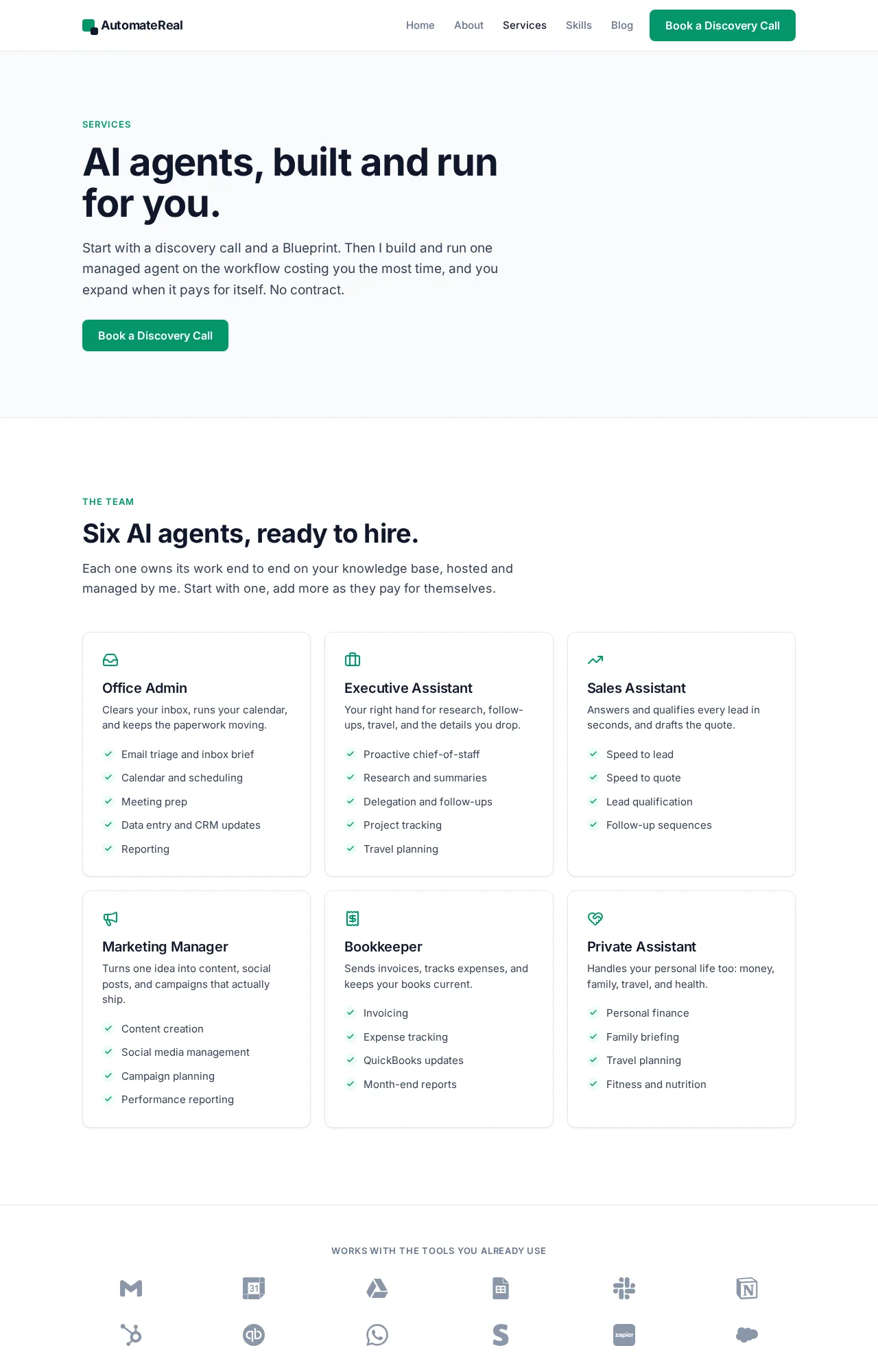 AutomateReal services
You keep the plan whether or not you build.
FAQ
How much does it cost to hire a custom AI agent development company?
Vendor estimates run from $25,000 for a simple agent to $400,000 and up for a multi-agent system (its published ranges). Budget the run cost on top. Model usage, hosting, and monitoring are monthly lines.
Can a small business with no technical staff hire one?
Yes, if the scope is one workflow and the vendor owns the operations. You need one person who knows the process well enough to write the 30 cases. That person is usually the owner, and the job takes about 2 hours rather than a technical background.
Do we own the code and the prompts when the project ends?
Only if the contract says so. Ask for assignment of the repo, the prompts, and the test set on final payment. Add a data export in a readable format. A license to use their tool is a different deal, and it ends when you stop paying.
How long does a custom AI agent take to build?
Vendor timelines put a basic agent at 6 to 10 weeks and a mid-range build at 3 to 5 months (that same writeup). Ask for phase one at 4 weeks, at level 1 of the ladder. A build with no date you can test against is a retainer with a launch story.
What is the difference between an AI agent development company and an AI automation agency?
An automation agency wires tools together on fixed paths. A development company builds the decision layer, with a model choosing steps, a test set, and an owner after launch. Many firms sell both. Ask which one you are buying, and ask for the test set that proves it.
If you have a quote in hand and want a second read, a discovery call maps the acceptance test. It takes about thirty minutes, and it covers the 3 lines that usually go missing.
The AI services page shows how the build runs, from the workflow map to the first weekly report.