Best Free AI Agent Builders in 2026 (Free Tiers Tested)
Nine free AI agent builders compared on free tier limits, hosting and real model costs. See which free plan fits a small business, and where it stops.
A free plan is a trial with friendlier wording. The real question is how many days of work each one buys.
The best free AI agent builder depends on who runs it. For technical owners, n8n Community Edition is free to self-host with no run cap. For non-technical owners, Zapier Agents includes 400 activities a month free. Make gives 1,000 credits and MindStudio one agent with 1,000 runs. Every option still bills model usage separately.
Most pages on this keyword reprint a pricing table. I run my own automation stack every day, so I read these plans as someone who pays the bills. That changes which numbers matter.
TL;DR
- The allowance is counted in activities, credits, runs or steps. Your job is none of those, so convert it first.
- n8n Community Edition is the only full builder here with no execution cap, because it runs on your server.
- At 200 jobs a day, Zapier’s 400 activities cover 2 days of work.
- Budget the hours that keep the agent alive. They outlast every plan price on this page.
What makes an AI agent builder free?
Free means one of 3 shapes. Some plans give you a monthly allowance of units. Some give you a self-hosted licence you run yourself. The rest are timed trials, and the allowance plan is the one that runs out mid-month.
Allowance plans meter each step your agent takes, and every hosted builder below runs on one. Licence plans meter nothing. The compute bill arrives from your own server or cloud account instead.
n8n publishes both shapes on one page. The Community Edition is a self-hosted build you download from GitHub, and it carries no execution meter. The hosted Cloud Starter plan charges by execution: 2,500 a month for 20€ on annual billing.
Trials sit between those two. Gumloop’s own page now shows a 14-day trial and no standing free plan, which means the clock starts the day you sign up.
Every free plan is a metering choice. That is why the unit matters more than the price tag.
How we compared these free AI agent builders
I compared 9 builders on 5 things a small business pays for, and opened each vendor’s own pricing page on 1 November 2026. Two of those pages refused to serve their plan limits to a text read, and I say so where they appear.
- Real free ceiling: the agents, runs or activities left after the trial, in the platform’s own unit.
- What the unit buys per run: a unit from one platform is not a unit from another. A job that hits a per-run cap stops part way through.
- Model cost on top: whether the model comes bundled or bills through your own API key.
- Exit path: whether you can export the agent or self-host it on the day the plan changes.
- Who owns it after launch: the hours a month a non-technical owner spends keeping the agent alive.
Make blocked my read behind a bot check. Its 1,000 credits and the about $12 Core price come from the Pareto guide dated 22 October 2026. Zapier publishes its own 400 activities a month on the pricing page. The 10-activity cap per run on Free comes from that same Pareto guide.
A review with no volume to test against is a guess. My own lead-gen system takes about 200 form submissions a day, so I had a real number to hold these allowances against.
What does each free plan actually include?
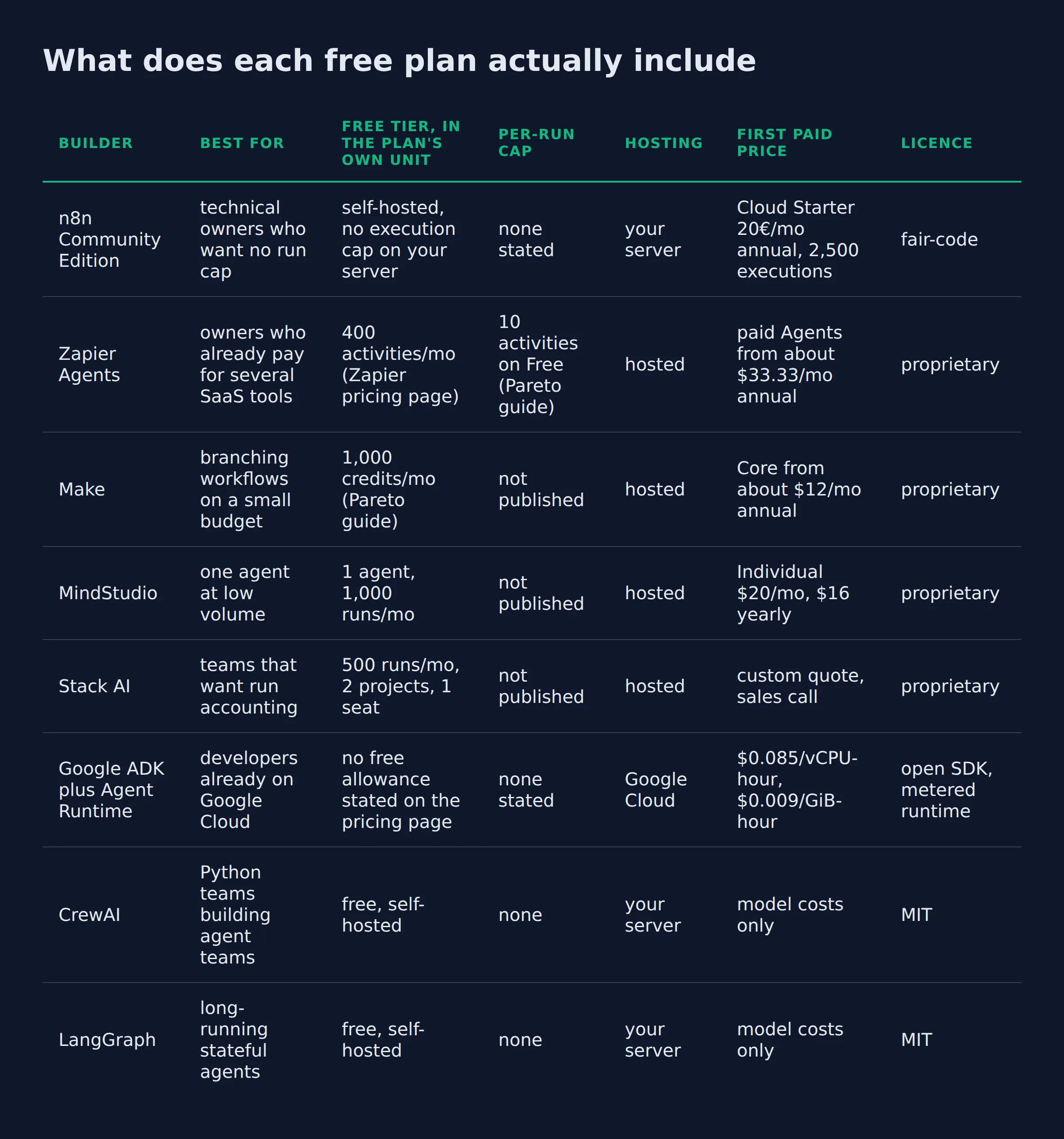
Zapier Agents allows 400 activities a month. Make allows 1,000 credits and MindStudio one agent with 1,000 runs. Stack AI allows 500 runs, and n8n Community Edition has no execution cap on your own server. Google’s Agent Runtime lists per-hour rates and no free allowance.
| Builder | Best for | Free tier, in the plan’s own unit | Per-run cap | Hosting | First paid price | Licence |
|---|---|---|---|---|---|---|
| n8n Community Edition | technical owners who want no run cap | self-hosted, no execution cap on your server | none stated | your server | Cloud Starter 20€/mo annual, 2,500 executions | fair-code |
| Zapier Agents | owners who already pay for several SaaS tools | 400 activities/mo (Zapier pricing page) | 10 activities on Free (Pareto guide) | hosted | paid Agents from about $33.33/mo annual | proprietary |
| Make | branching workflows on a small budget | 1,000 credits/mo (Pareto guide) | not published | hosted | Core from about $12/mo annual | proprietary |
| MindStudio | one agent at low volume | 1 agent, 1,000 runs/mo | not published | hosted | Individual $20/mo, $16 yearly | proprietary |
| Stack AI | teams that want run accounting | 500 runs/mo, 2 projects, 1 seat | not published | hosted | custom quote, sales call | proprietary |
| Google ADK plus Agent Runtime | developers already on Google Cloud | no free allowance stated on the pricing page | none stated | Google Cloud | $0.085/vCPU-hour, $0.009/GiB-hour | open SDK, metered runtime |
| CrewAI | Python teams building agent teams | free, self-hosted | none | your server | model costs only | MIT |
| LangGraph | long-running stateful agents | free, self-hosted | none | your server | model costs only | MIT |
Every price in that table comes from the vendor’s own page, opened on 1 November 2026. Make and Zapier’s per-run cap are the exceptions, and both come from the Pareto guide dated 22 October 2026.
Relay.app held a row here until I opened its site. The product page now says Relay.app shut down in September 2026. Every account and workflow was deleted, and the run history went with them. A free tier can end for reasons that have nothing to do with your usage.
Several famous names sit outside this comparison. Salesforce Agentforce and Gemini Enterprise sell to departments, so their pricing never starts at zero. Voiceflow designs voice and chat flows, which is a different job from a business workflow.
Microsoft Copilot Studio has no free plan, and the Copilot Studio guide covers it. OpenAI’s AgentKit and the Anthropic Agent SDK belong to developers who write code, so they appear in the self-hosted section instead.
Read the unit column before the price column. Make counts credits. Zapier counts activities, n8n counts executions and MindStudio counts runs. Those 4 units are 4 different sizes, so compare jobs a month before you compare prices. Google splits the meter again, billing compute by the hour and memory by the gigabyte-hour on the Vertex AI price list.
The free builders that need no coding
Five of the 9 build an agent without writing a line of code. Each one still meters the work in its own way, and each one stops at a different point.
The no-code group is where most owners start, and the blocks below show where each plan ends.
- Zapier Agents fits an owner who already runs several SaaS tools and wants the 9,000+ app connectors that come with them. Free covers 400 activities a month with a 10-activity cap per run. Paid Agents start near $33.33 a month on annual billing. Weakness: a 15-step job dies at that cap mid-run, and every tool call spends quota.
- Make fits branching workflows on a small budget. Free carries 1,000 credits a month, and Core starts near $12 a month on annual billing. Weakness: an AI step can cost more than one credit, so the plan empties faster than the credit count suggests.
- MindStudio gives one agent and 1,000 runs a month on the Free plan, with 200+ models reachable without an API key. Individual is $20 a month, or $16 on yearly billing. Weakness: the paid tier adds usage charges on top of the platform fee, so the model bill becomes your variable.
- Stack AI fits a team that wants to see run accounting. The Free plan gives 500 runs a month across 2 projects and 1 seat. Weakness: the next step is a custom quote, so there is no published number to budget from.
- Gumloop no longer shows a standing free plan on its pricing page. Pro starts at $37 a month with 20k credits after a 14-day trial. Weakness: a trial is not a free tier, and the burn rate depends on which step types you use.
A no-code builder states its limit plainly once you read the meter. It cannot tell you your step count, though. That number comes from your own workflow.
Which free agent builders can you self-host or run open source?
n8n Community Edition is the only full builder here that self-hosts free, with no execution cap on your own server. CrewAI and LangGraph are MIT-licensed frameworks you run yourself. Google’s Agent Runtime runs code on Google Cloud at $0.085 per vCPU-hour.
Self-hosting moves the bill from a subscription to a server and a person. You pay for a server now. The model calls bill separately, and the hours to keep the box patched land on someone on your side.
n8n is fair-code rather than MIT, so read the licence before you wrap it for customers. The self-hosted build is low-code, with code nodes for the parts the visual editor cannot reach. The n8n AI agent builder explainer covers how the pieces fit.
CrewAI and LangGraph take the trade further, since you write the orchestration yourself. Both repos carry the MIT licence, and LangGraph is the stateful layer from the LangChain team. The LangGraph guide walks through the code side.
Code frameworks leave the connector work to you as well. When your agent has to reach a tool, you wire that connection yourself, including any Model Context Protocol (MCP) server you already run.
- CrewAI suits a Python team building a multi-agent setup, with roles that hand work to each other. First paid price is model tokens only. Weakness: you own every failure, from retries to logging.
- LangGraph suits long-running work that resumes where it stopped. First paid price is model tokens only. Weakness: the ideas behind it take a developer, so a non-technical owner cannot maintain it.
- Google Agent Runtime suits a team already inside Google Cloud, where compute bills through the Vertex AI price list. Weakness: I found no free monthly allowance on that page, so the meter runs from the first call.
My own outreach stack runs on a server I patch myself. That chore repeats every month, and no pricing page lists it.
Self-hosting trades a subscription for maintenance hours, and the trade only pays if someone on your side can patch a box.
How much does a free agent cost once the tier ends?
Between 8€ and $22 per 1,000 units on the hosted entry plans, and $85 per 1,000 vCPU-hours on Google’s runtime. Model tokens are billed separately, and that token bill is where a busy agent costs real money.
| Paid entry tier | Units included | Cost per 1,000 units |
|---|---|---|
| n8n Cloud Starter, 20€/mo annual | 2,500 executions | 8€ |
| MindStudio Individual, $20/mo | 1,000 runs | $20 |
| Zapier Agents, about $33.33/mo annual | 1,500 activities | $22.22 |
| Agent Runtime, metered | none bundled | $85 per 1,000 vCPU-hours |
The units are different sizes, so treat this as a floor for the platform bill rather than a total. Now run the volume test.
At 200 jobs a day you need 6,000 units a month, if each job spends one. That is the gentlest assumption available, and it is still harsh on every free plan.
| Free allowance | Days before the meter empties at 200 jobs a day |
|---|---|
| Zapier Agents, 400 activities | 2 |
| Make, 1,000 credits | 5 |
| MindStudio, 1,000 runs | 5 |
| Stack AI, 500 runs | 2.5 |
| n8n Community Edition, self-hosted | no cap, the server is the limit |
The 200 jobs a day is my own number. That system pulls in roughly 200 form submissions a day, and each one starts a follow-up job. If your volume is lower, scale the table down rather than trusting mine.
MindStudio writes the model bill into the plan line itself, as “$20 /month + usage”. That plus sign explains the shape of every hosted bill on this page. The platform rents you the plumbing, and a model provider charges for the thinking.
A shutdown is the other end of the exit path. OpenAI told developers on 3 June 2026 that Agent Builder is being deprecated. The deprecations page schedules the shutdown for 30 November 2026, with a migration path to the Agents SDK or ChatGPT Workspace Agents. The Agent Builder guide covers what that means for a saved agent.
At 200 jobs a day, a 400-unit free plan is a 2-day trial, whatever the vendor calls it.
Which free AI agent builder fits your business?
A solo owner with no technical help should start on Zapier Agents Free. An owner who will pay a developer once is better on self-hosted n8n. A Python team should take LangGraph or CrewAI and skip the platform bill.
- Solo owner, no technical help: Zapier Agents Free, until the 400 activities run out.
- Solo owner who will pay a developer once: n8n Community Edition on your own server.
- Agency or ops person with branching workflows: Make first, then Gumloop at $37 a month once volume climbs.
- Developer who wants to own the code: CrewAI or LangGraph, MIT licensed and self-hosted.
- Team that needs human-in-the-loop approvals: build that pause into a system you control, because Relay.app shut down in September 2026.
- Anyone already on Google Cloud: Agent Development Kit plus Agent Runtime at $0.085 a vCPU-hour.
When the workflow needs building rather than buying, that work sits on the AI services page. The build is scoped around one job, not a platform subscription.
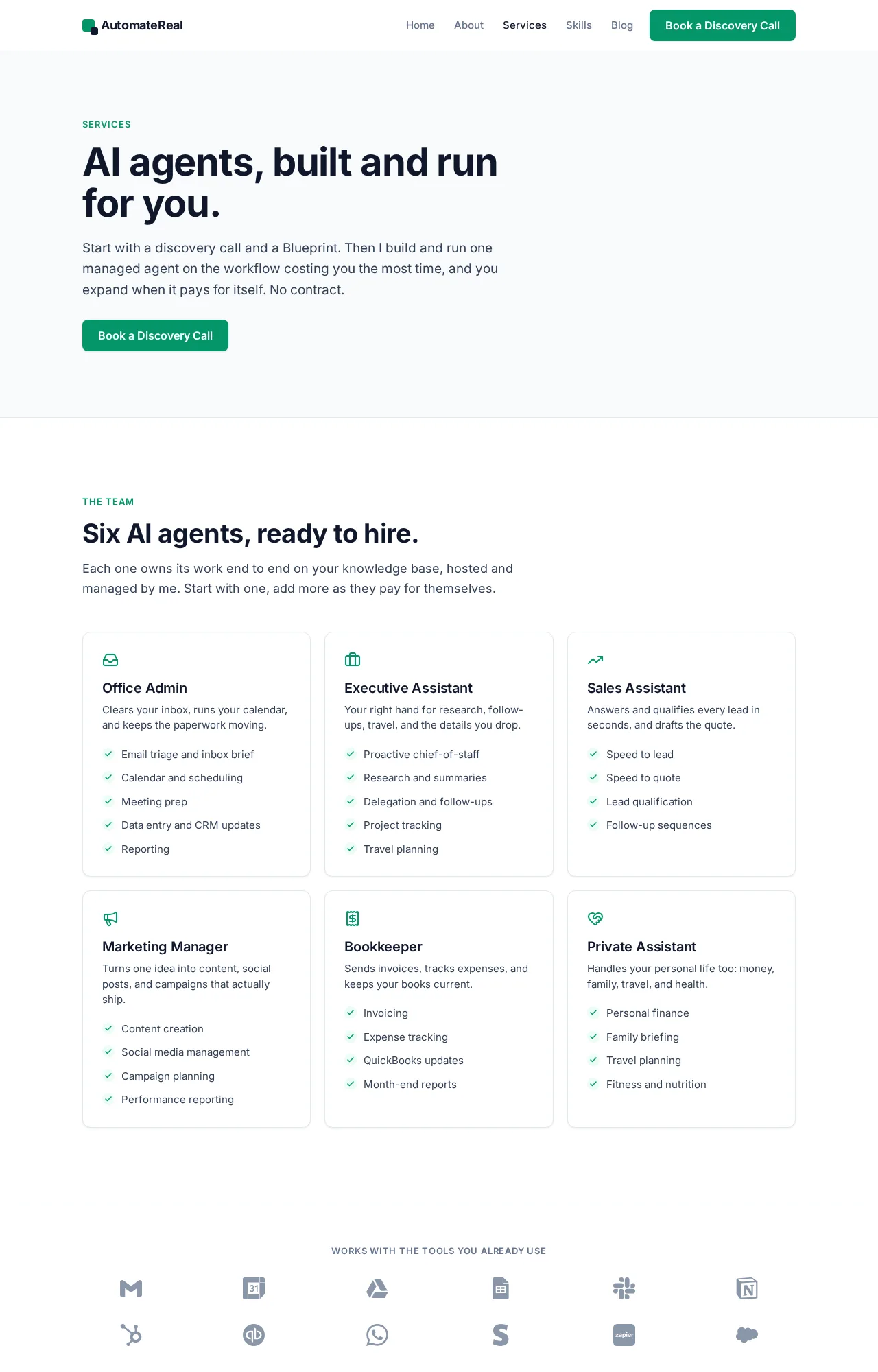
The AutomateReal services page: one workflow scoped around a single job, not a subscription.
Pick the row that matches who will own the agent. That owner decides the plan more than the feature list does.
How do you build your first agent on a free plan?
Count the steps in one job you repeat weekly, multiply that by 4, and pick the free tier that covers the total. Build that single job first, run it on real data for a week, then add a second.
- Write down the job in 5 steps or fewer, in the order you do it today.
- Run it once and count every action the agent takes, from the first lookup to the final send.
- Multiply by 4 runs a month. That number is the one you plan and pay for.
- Pick the free tier that clears it with room for a bad week.
- Check the meter on day 7. If you burned more than a quarter, the paid tier is coming.
Step 2 is the one that catches people. A follow-up job looks like one action and bills as several. The lookup bills once. Then the draft bills, and the send bills after that.
I build free websites for prospects before they pay me. That free build proves the work. A free tier carries the same weight for a builder.
The how to build an AI agent walkthrough covers the build order once the plan is picked.
Run one job for a week on real data, then count the units you burned.
When is a free builder the wrong choice?
A free builder is the wrong choice when one job needs more steps than the per-run cap allows. It fails when a person must approve every output, or when a dropped record costs more than the plan. The bill is rarely the reason.
Look at the cost of a miss. A quote that never sends loses the job. A follow-up that fires twice costs the customer’s trust. Each of those costs more than a month of the plan.
Most lists of ai agents for small business skip that failure cost. A production build has to clear a per-run cap and log every run. It also needs an approval step that a person actually signs off on.
That job is different from a demo agent, and it is the one I scope on the AI services page after a workflow review.
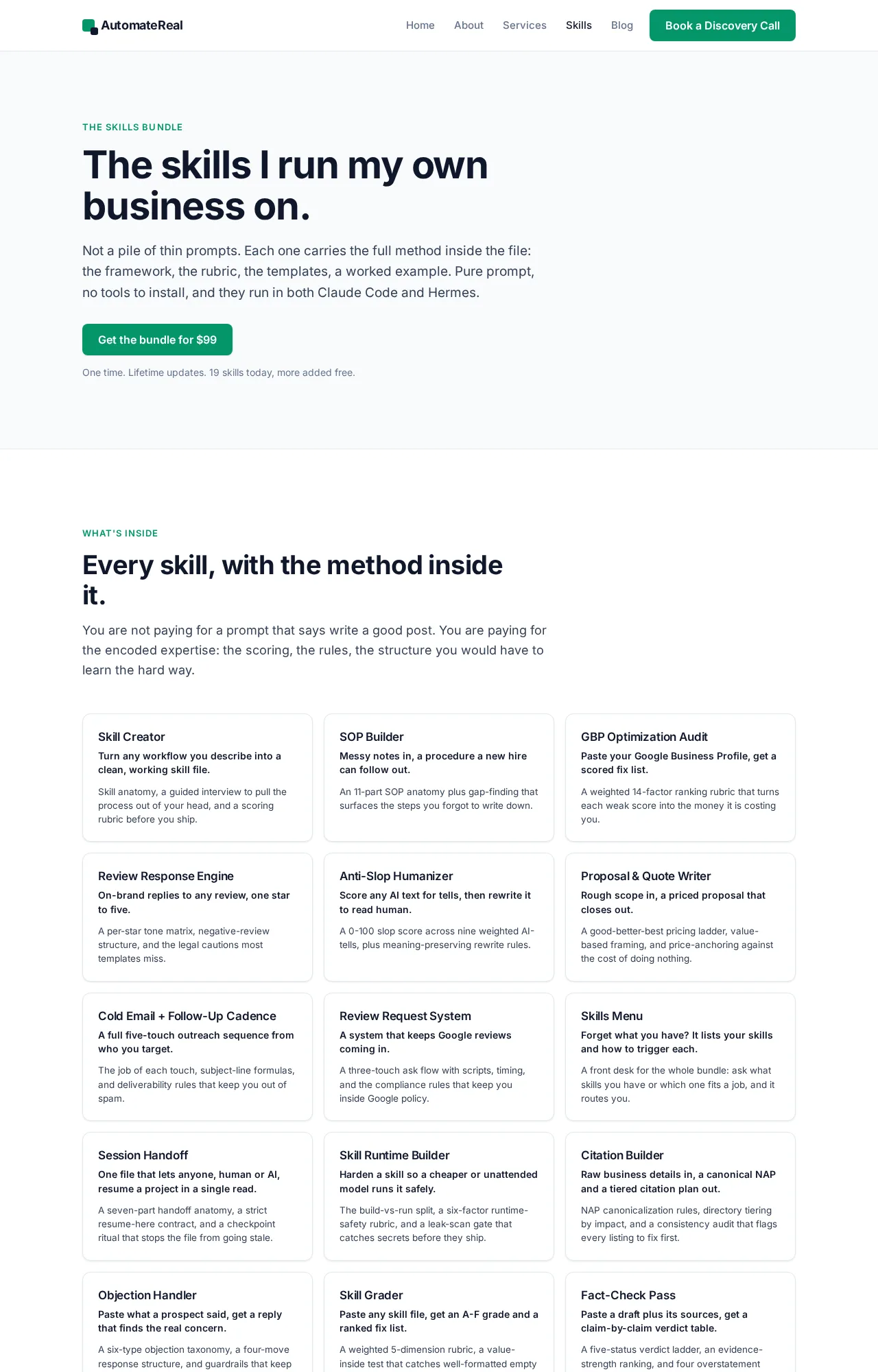
The AutomateReal skills page: the 3 parts packaged as a build.
If the free tier covers your job, keep it. Free is a fine place to start. The meter will tell you when it is not.
Log every run for the first month. A quiet failure is the expensive kind.
Pick the plan whose failure mode you can live with, because all of them fail at some volume.
FAQ
Is there an AI agent builder that is genuinely free with no limits?
Self-hosted n8n Community Edition comes closest. There is no execution cap on your own server, and you still pay for the server and the model calls. No hosted builder on this page is free without a limit.
Every hosted plan here carries a number. The self-hosted build carries a server bill instead.
Do free AI agent builders include the cost of the AI model?
Most do not. The platform meters the automation step, and the model bills through your own API key or a usage line on top of the plan.
MindStudio makes that explicit by writing “+ usage” next to every price on its pricing page. Treat the model bill as a separate line when you build the budget.
Which popular agent builders have no free plan?
Lindy has no standing free plan, just $50 in credits that expire after 7 days. Team then costs $49.99 a month for 5,000 credits.
Those numbers sit on the Lindy pricing page, and the Lindy guide covers the trade.
Microsoft Copilot Studio has no free tier either. It sells prepaid Copilot Credits in tenant-wide packs of 25,000 for $200 a month, per its Copilot Studio product page.
Can you build an AI agent for free with no coding at all?
Yes, inside the allowance. MindStudio’s 1,000 runs a month will carry one small weekly job. Make’s 1,000 credits covers the same job.
That is a real agent doing real work. It stops being free the week the volume arrives.
What happens to your agent when a free platform shuts down?
You lose it, along with its history, unless you exported it first. Relay.app deleted every account and workflow when it shut down in September 2026. OpenAI’s Agent Builder is scheduled to shut down on 30 November 2026.
The Relay.app site says the run history went with them. Ask 2 questions before you build: can I export the definition, and can I run it somewhere else. A platform that answers no to both is a rental.
Is OpenAI’s Agent Builder still free to use?
It is free to use until the scheduled shutdown on 30 November 2026. After that the documented path is the Agents SDK or ChatGPT Workspace Agents.
The deprecation was announced on 3 June 2026, and the deprecations page carries both dates.
Do any free AI agent builders skip the credit card?
n8n Community Edition skips it, because it is a download rather than a signup. n8n’s Cloud trial also states no credit card required on its pricing page.
For the other vendors I could not confirm the signup flow without creating accounts, so check the card field before you start.
One job on a free tier is the cheapest way to learn whether automation fits your week. If you want that job mapped and the limits checked before you build, a discovery call covers it in about 30 minutes.